
Don’t rely on luck for your Twitter tweets for most of your reach. If you understand “how to rank tweets organically with Twitter SEO” you can win most followers with few posts.
There’s a lot more to Twitter than hot takes and trending conversations. It’s like a search engine. People use it every day to find out about news, ideas, expert opinion, products and immediate answers. This means your tweets can appear in front of people who don’t follow you yet. With the right approach, you can appear in Twitter search, surface around relevant topics and even appear in Google results.
That’s the power of Twitter SEO.
This guide will tell you exactly how to make your tweets more discoverable, and useful to your audience and how to get organic reach without spending a single dollar on ads.
 Time killer · Pain
Spending 6 hours writing posts that get zero traction?
Paste your URL. ZuAI turns it into 30 brand-on captions in 10 minutes — no blank-page panic, no generic AI filler.
What is Twitter SEO

Twitter SEO is the process of making your profile and tweets easier to find when people search.
The aim is pretty simple : help Twitter understand what your content is about, who it is for, and when it should be shown to people searching related topics.
It’s like traditional SEO, but the ranking signals are different. Twitter Visibility is based on:
- The keywords you use in your profile and tweets,
- Your chosen hashtags,
- How much engagement your tweet gets,
- How current and up-to-date your content is,
- Your profile’s relevance to the topic you’re writing about, & finally
- Consistency of posting on similar subjects.
When you tweet about social media strategy, content marketing, or Twitter growth regularly, Twitter starts to associate your account with those topics. And when people search for them, your content has a real chance of appearing.
Outcome · RecommendedGet 30 days of social content from your website — in 10 minutes.
Why Twitter SEO is Important
Many brands still think of Twitter as a broadcast channel, where they announce blog posts, share company news, or recycle LinkedIn captions. It can work sometimes but it’s not a plan.
Twitter SEO helps your content have a better chance of being found by people who are already interested in what you cover. And that means you reach more marketers, creators, founders and social media managers.
- Organic reach: It is free and sustainable through search-driven discovery and no paid promotion needed.
- More brand visibility: People find you through topics they already care about.
- More niche authority: Being regularly in the same searches builds credibility.
- More relevant followers: Discovery through search tends to draw in people who are actually interested.
- Extended content life: A well-optimized tweet can continue to attract attention long after it’s posted.
In short, Twitter SEO helps your tweets do more than just dissipate in a feed after a few minutes.

Proof · Verified
2k+ grew faster with one tool.
How to Optimize Your Tweets for Organic Reach
Ranking tweets organically is not about manipulating the algorithm. It’s about making your content clear, discoverable and worth engaging with. The main points are:
- Choose the right keywords.
- Use hashtags strategically.
- Build Tweets people will reply to.
- Post during peak times.
- Keep the topics consistent.
- Analytics keep getting better.
Let’s explore each point now.
1. Use Keywords Your Audience Is Really Searching For
Twitter search is very word-based. So, if somebody’s looking for “content marketing tips” or “twitter growth strategy,” Twitter will match those terms with tweets and profiles containing those terms.
If you want your content to rank for a topic, you have to use the same language your audience uses and avoid corporate jargon or buzzwords. This principle applies beyond Twitter, too. SaaS brands building long-term organic visibility may also use a saas link building agency alongside their content strategy to strengthen the authority and discoverability of their website.
Do your research first. Type your topic into Twitter’s search box. Check the auto-complete suggestions, then check the top results.
Identify:
- Repetitive phrases and questions.
- Hashtags that people use regularly.
- Style & tone of top-performing tweets.
- Existing trending problems and conversations.
For example, if your focus is Twitter growth, relevant search phrases could be:
- Twitter SEO
- grow organically on Twitter
- Twitter marketing tips
- social media strategy
- SEO content strategy
When you know what those terms are, use them naturally in your tweets.
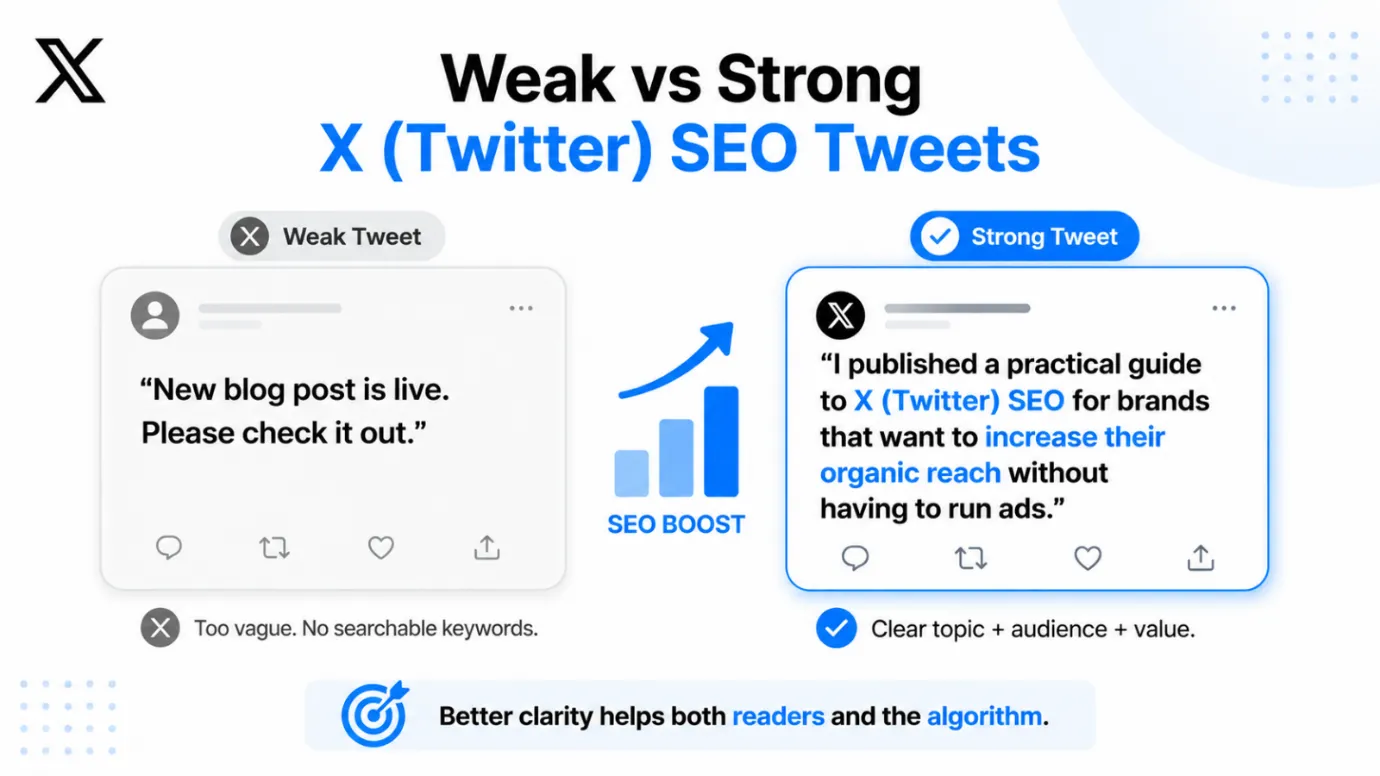
Here is a quick comparison idea between a weak and stronger tweet
Weak: “New blog post is live. Please check it out.”
Stronger: “I just published a practical guide to Twitter SEO for brands that want to increase their organic reach without having to run ads.”
The second one gives a lot more for both the readers and Twitter’s algorithm. It tells you what it’s about. Who it’s for. What’s in it for them. In one sentence.
Your profile matters here as well. Make sure to add relevant keywords to your bio, display name and pinned tweet where they fit naturally. If you work with B2B companies on content marketing, you can also offer SaaS link building services to improve their online visibility. The more simply you make it for Twitter to understand your niche, the more simply you make it for the right people to find you.
2. Be Intentional with Hashtag
Hashtags can support discovery, but only when done intentionally.
One of the biggest mistakes most marketers and Twitter users do is overloading tweets with hashtags. Six or eight hashtags on a tweet can make it look cluttered and spammy, detracting from your actual message. Studies show that one or two relevant hashtags in a tweet are more successful than five or more relevant hashtags.
A good way to do this is a broad hashtag and a specific hashtag.
A broad tag like #Marketing will have a lot of competition but also a wider reach. A more specific tag such as #B2BContentMarketing has a smaller pool but often connects you with a far more relevant crowd.
Click on any hashtag before using it. Consider:
- Is the hashtag active and used frequently?
- Are the posts around it is relevant to the brand?
- Will it be attractive / fit target audience?
- Anything off brand in chat?
This quick check will prevent you from attaching your content to hashtags that aren’t actually working for your goals.
Don’t create hashtags that no one is searching on. Brand campaign hashtags can work, but they need support from the existing, and established hashtags for organic discovery.
3. Write Tweets People Want to Reply To
Keywords help people discover your Tweet. Engagement helps it to grow.
Twitter’s algorithm pays attention to how people react to your content. Replies, reposts, likes, bookmarks and clicks all mean your tweet has value and will lead to broader visibility.
This is where many brands fail. They optimize the words and miss a few things. As a result, the tweet itself feels flat or like it’s for their own benefit.
A good tweet usually does one of the following things:
- Offers something immediately useful.
- Asks a clear, inviting question.
- Provides a specific data point or insight.
- Challenges an assumption.
- Addresses a timely trend thoughtfully.
- Simplifies a complex subject matter.
- Starts a real and interesting conversation.

Questions are powerful things. A tweet like “What’s one Twitter SEO tactic that actually moved the needle for your organic reach?” gives people an easy reason to reply. And every reply is a signal to the algorithm that your content is worth amplifying.
Data works fine too. Original insights, survey findings, campaign numbers and industry stats are easily shared. People repost certain information because it helps them to make a point or support an argument.
Visuals can assist. Plain text tends to be less effective at stopping the scroll than screenshots, short videos, charts and simple graphics. If you use images, add descriptive alt text. This makes your content more accessible and easier to index.
4. Make Your First Line Matter
Tweets travel fast. Your opening line needs to make people stop and say, “This is worth my time.”
A good opening can:
- Learn a problem your audience is aware of.
- Provide a clear, useful takeaway.
- Present a surprising or counterintuitive fact.
- Argue against a commonly held belief.
- Create real curiosity.
Take for example:
- Most brands are doing hashtags wrong and it’s quietly killing their reach.
- Twitter SEO: It’s not just keywords. The one thing most guides leave out.
- What’s Likely Happening If Your Tweets Are Getting Impressions But No Clicks?
Each of those is due the next line. They give the reader, or the searcher scrolling past the results, a clear reason to keep scrolling.
Avoid generic openers like “Big news!” or “New post is live” unless you already have a highly engaged audience. Those openings don’t give a first-time visitor any reason to care.
5. Use Threads for Topics That Deserve More Space
Some ideas are too big for one tweet. That’s why we have threads.
A good thread structure lets you go deep on a topic while keeping each individual post tight and readable. Especially threads can be used for:
- How-to guides.
- Real life cases and case examples.
- Industry breakdowns or trend analysis.
- Lessons learned or behind-the-scene insights.
- Frameworks and checklists.
Your first tweet does much of the heavy lifting. The title should clearly say what the thread is about and why one should keep reading.
For example: “Want to increase your Twitter SEO without tweeting more often? These 7 simple changes can help people discover your tweets organically.
That opener tells the reader what they will learn, who it is for, and what they will get. Every tweet in the thread should build upon the previous one cleanly structured, easy to follow, without any unnecessary fluff.
6. Post When Your Audience Is Online
Timing makes a real difference in performance. If you fire off a killer tweet when your audience is offline, it will almost always perform worse than it would have otherwise. Early engagement helps tweet to gain traction and signal the algorithm that people care.
There’s no single best time to post. B2B audiences are generally most active during the week days. Consumer brands tend to see stronger engagement in the evenings and on weekends. But your audience may react otherwise.
The only way to know for sure is to try.
Post at various times of the day on different days. Impressions, engagement rates, replies and clicks patterns will emerge eventually. If your account is consistently better on a Tuesday morning than on a Thursday afternoon, that’s data you should act on.
Tools like indzu can help you schedule ahead and publish at the best times, without having to be logged on all the time. Use them wisely, and revisit the data regularly to make sure your timing assumptions are still correct.
7. Consistency in your Topics
Consistency is not posting 20 times a day. This means consistently showing up and building a clear association between your account and the topics you want to be known for.
If you want to rank for Twitter SEO, content marketing or B2B social media strategy, you have to write about those topics consistently. That repetition has two purposes:
- Your audience will know what to expect from you and are more likely to follow, share and engage.
- Twitter produces stronger indicators of what your account is about, increasing the chances your content will appear in relevant searches.
For most brands and creators, a steady posting rhythm is better than an intense one. Some targeted, high-quality tweets per day will beat random bursts and long silences.
The key is to be consistently present around your core topics. Consistency builds trust with your audience, and Twitter platform.
8. Use Twitter Analytics to refine your strategy
What separates a guess from a real strategy is data. Twitter Analytics gives you clear feedback on what’s working, what’s not and where to focus next.
Metrics | What it tells you |
Impressions | How many times your tweet was seen by the users? |
Engagement rate | How often people interacted with your tweets? |
Replies | How much it generated conversations in the platform? |
Reposts | How many people have reposted it? |
Bookmarks | Whether people found it worth saving |
Link Clicks | Did it drive traffic? |
Follower growth | Did it reach the right audience? |
Don’t read a tweet in isolation. See if you can detect patterns in your content over time.
Consider: Which topics generate the most engagement? Do threads do better than single tweets? Do more replies come to questions? What hashtags are actually effective? What times of day are most effective?
Then do something about it.
If practical tip tweets consistently outperform opinion posts, tweet more practical tips. If some hashtags aren’t doing anything, swap them. If your morning posts are doing better than the evening ones, then change when you post.
Your analytics are not just numbers; they are feedback coming directly from your audience. Review them at least once a month to stay on top of what’s working.
Free · Instant · No signupSee what ZuAI generates from your website — right now.
Paste your URL. Watch ZuAI write a month of brand-on captions in seconds. Preview before you create an account.
Examples of SEO Friendly Tweets
This is what the principles look like in practice:
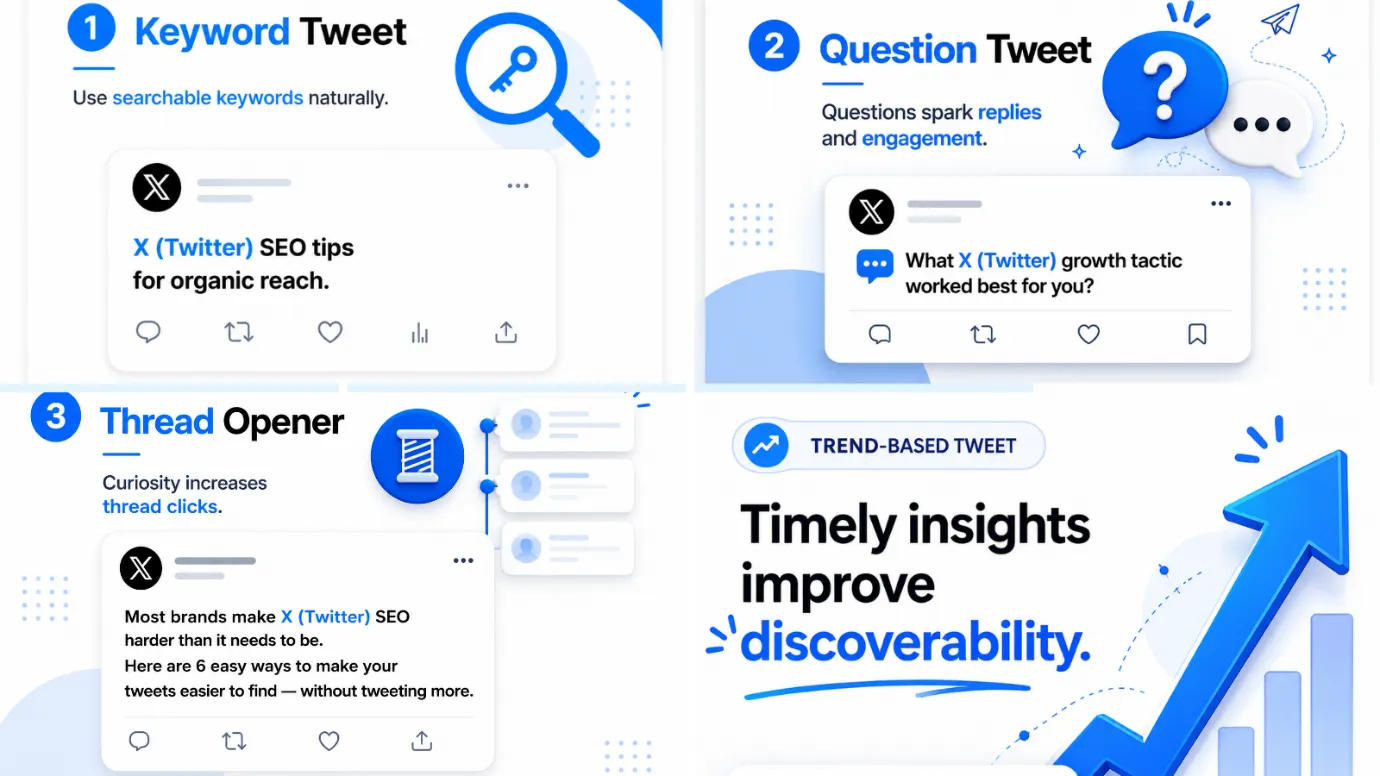
Example 1:Tweet focused on a keyword
Twitter SEO is one of the most underused tools for organic reach. Start with your bio, pinned tweet and the keywords you repeat the most in your content.
Use target keywords organically to deliver a clear and actionable tip.
Example 2: Question based tweet
One Twitter marketing tactic that worked for me in growing organic reach this year are question tweets.
Question based tweets encourages real conversation, searchable terms, and invites replies.
Example 3: Thread Opener
Here is an interesting example.
“Most brands make Twitter SEO harder than it needs to be. Here are 6 easy ways to make your tweets easier to find — without tweeting more.”
This type of tweets creates curiosity, offers clear value, and sets up a useful thread.
Example 4 :Timely, topic-driven tweet
“Twitter search is becoming one of the most underrated discovery channels for brands. If you’re not optimizing your tweets for keywords and clear positioning, you’re missing out on consistent organic reach.”
These tweets links current behavior to an actionable marketing insight.
Speed · 10-minute setupOne coffee from URL to a full month of scheduled posts.
Drop your URL, brew your coffee, come back to 30 brand-on captions ready to publish.
Typical SEO Mistakes to Avoid on Twitter
Small habits can quietly restrict your reach. Look out for these:
- # Too many hashtags. One or two relevant hashtags will almost always do a better job than a string of five or more. Overloading looks spammy, and waters down your message.
- Generic tweet copy. If your tweet is not clear about what it is about, neither Twitter nor your audience will know how to respond. The specific always beats the generic.
- Ignoring your profile. Your bio is vague or your pinned tweet doesn’t represent your niche and your tweets can only do so much. Your SEO profile is your presence.
- No topical focus. If you’re tweeting about totally different things every day, it makes it harder for the algorithm (and people) to understand what you are about. Personality and variety are good, but your main themes have to be recognizable.
- Skip the analytics review. If you don’t test what works, you’ll keep building the same patterns. A monthly review can show you what to double down on, and what to let go of.
Blank tab. Six open browsers. No clue what to post.


 After · With Indzu
Paste one URL. Get 30 scheduled posts.
A Simple SEO Checklist for Twitter
Before you publish, ask yourself these quick questions:
- Does this tweet naturally include a relevant keyword?
- Is the message of the first line obvious?
- Would my target audience actually use this?
- Am I using hashtags only where they add real value (one or two, max)?
- Why would somebody want to reply to, repost or save this?
- Is my audience likely to be active at this time?
- Does this connect to the topics I want to be connected with?
You don’t have to overthink every tweet. But it takes less than a minute to run through this list and it consistently results in more intentional content.
Time killer · Pain
Spending 6 hours writing posts that get zero traction?
Paste your URL. ZuAI turns it into 30 brand-on captions in 10 minutes — no blank-page panic, no generic AI filler.
Final Thought
Twitter SEO is not about gaming the algorithm. This is about making your content easier for people to grasp, easier for them to locate, and genuinely more beneficial to those you aim to serve.
The basics are simple: use the words your audience is looking for, choose your hashtags strategically, write tweets that will get you engagement, post regularly on your main topics and let your analytics show you what to do next.
You don’t need a huge following to see results. You need clear positioning, useful content and a repeatable process you can maintain. Use post generation tools like Indzu for consistent posting and analytics.
Choose one thing to improve this week. Use better keywords in your bio, create a thread around a single keyword, try a new posting time or spend ten minutes reviewing the top-performing tweets you’ve made over the last month.
Small, deliberate changes accumulate over time. And over time, they can make Twitter a dependable, sustainable source of organic visibility.